
Hire us
Hire us to get the best work of your life. Our award winning team will take care of your product as we care about our reputation.
Get started

Schlumberger's innovative AI approach to well completion optimization
In the oil and gas sector, optimizing performance and managing resources is crucial. Schlumberger, a renowned name in the industry, addresses this problem with an innovative software tool that predicts filling fluid needs for post-extraction. These predictions help them use fluid efficiently by reducing procurement and disposal costs. The tool uses data analytics to help operators make better decisions, streamline operations, and manage resources more effectively.
Oil extraction often requires fluids for hydraulic fracturing, cooling, and maintaining reservoir pressure. The amount needed varies based on reservoir type, extraction technology, and geological conditions. Hence, the challenges were to collect and integrate data from various sources, including well logs, drilling reports, and real-time sensor data. Identifying complex patterns and correlations in the data to make accurate predictions. Accounting for the variability in well characteristics and geological conditions. Ensuring optimal fluid usage without compromising the efficiency of the extraction process.

Collaborating with Schlumberger, we developed a sophisticated well optimization tool tailored to the industry’s requirements. Leveraging a team of AI and ML experts, Schlumberger incorporated innovative solutions to enhance operational efficiency and resource management in the oil and gas sector.
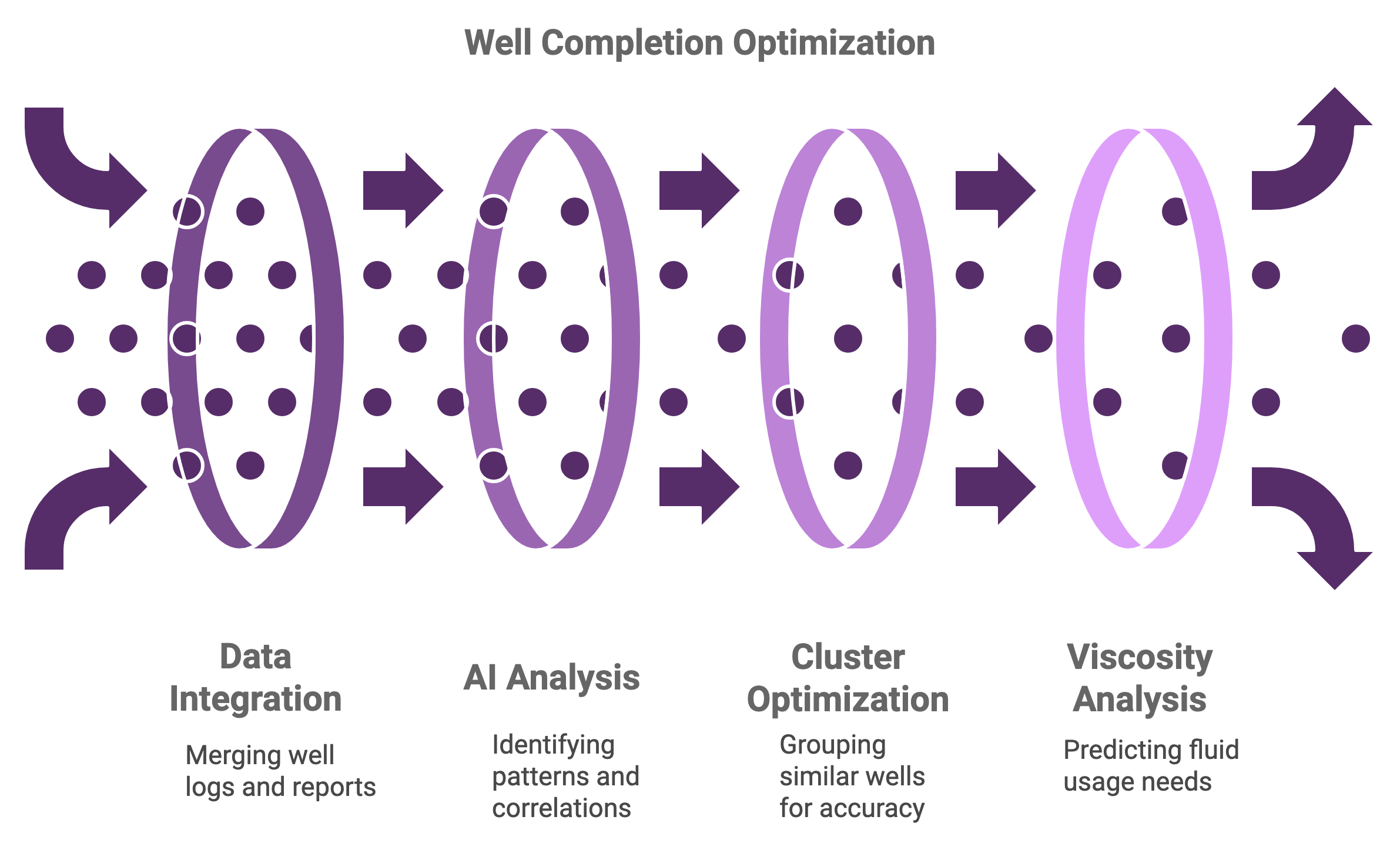
Data is integrated from multiple sources, including well logs, drilling reports, and real-time sensor data. Here, well logs provided geological formation details, drilling reports covering drilling activities and progress, and sensor data monitored parameters like pressure and flow rates. This comprehensive data set ensured accurate analysis and prediction.
AI algorithms process and analyze complex data and provide meaningful information. The tool identified patterns and correlations, such as the relationship between oil extraction volume and fluid requirements. These insights were crucial for making accurate predictions and optimizing filling resource usage.
By grouping similar wells, prediction accuracy improves. Applying the same models to these wells enhances reliability. Additionally, viscosity analysis of extracted materials helped predict resource requirements, leading to more precise fluid usage predictions.
Data is integrated from multiple sources, including well logs, drilling reports, and real-time sensor data. Here, well logs provided geological formation details, drilling reports covering drilling activities and progress, and sensor data monitored parameters like pressure and flow rates. This comprehensive data set ensured accurate analysis and prediction.
AI algorithms process and analyze complex data and provide meaningful information. The tool identified patterns and correlations, such as the relationship between oil extraction volume and fluid requirements. These insights were crucial for making accurate predictions and optimizing filling resource usage.
By grouping similar wells, prediction accuracy improves. Applying the same models to these wells enhances reliability. Additionally, viscosity analysis of extracted materials helped predict resource requirements, leading to more precise fluid usage predictions.
Hire us to get the best work of your life. Our award winning team will take care of your product as we care about our reputation.
Get started